I recently reread Business Model Generation (Classic Retranslation Edition) (《商业模式新生代(经典重译版)》), co-authored by Alexander Osterwalder and Yves Pigneur. What moved me most about this book isn’t how many novel cases it provides, but that it proposes a unified business language — the Business Model Canvas. When we discuss a company, a startup project, or even a personal career path, we often talk past each other; this book breaks complex business operations into nine modules that can be discussed, modified, and validated, turning the “business model” from a vague concept into a diagram you can actually draw.
1. Why We Need the Business Model Canvas
Right at the start the authors point out a pain point: the business world lacks a common language. Strategists talk positioning, finance looks at statements, product managers talk features, and sales only cares about conversion rates. Everyone is describing the same company, but using completely different vocabulary and dimensions.
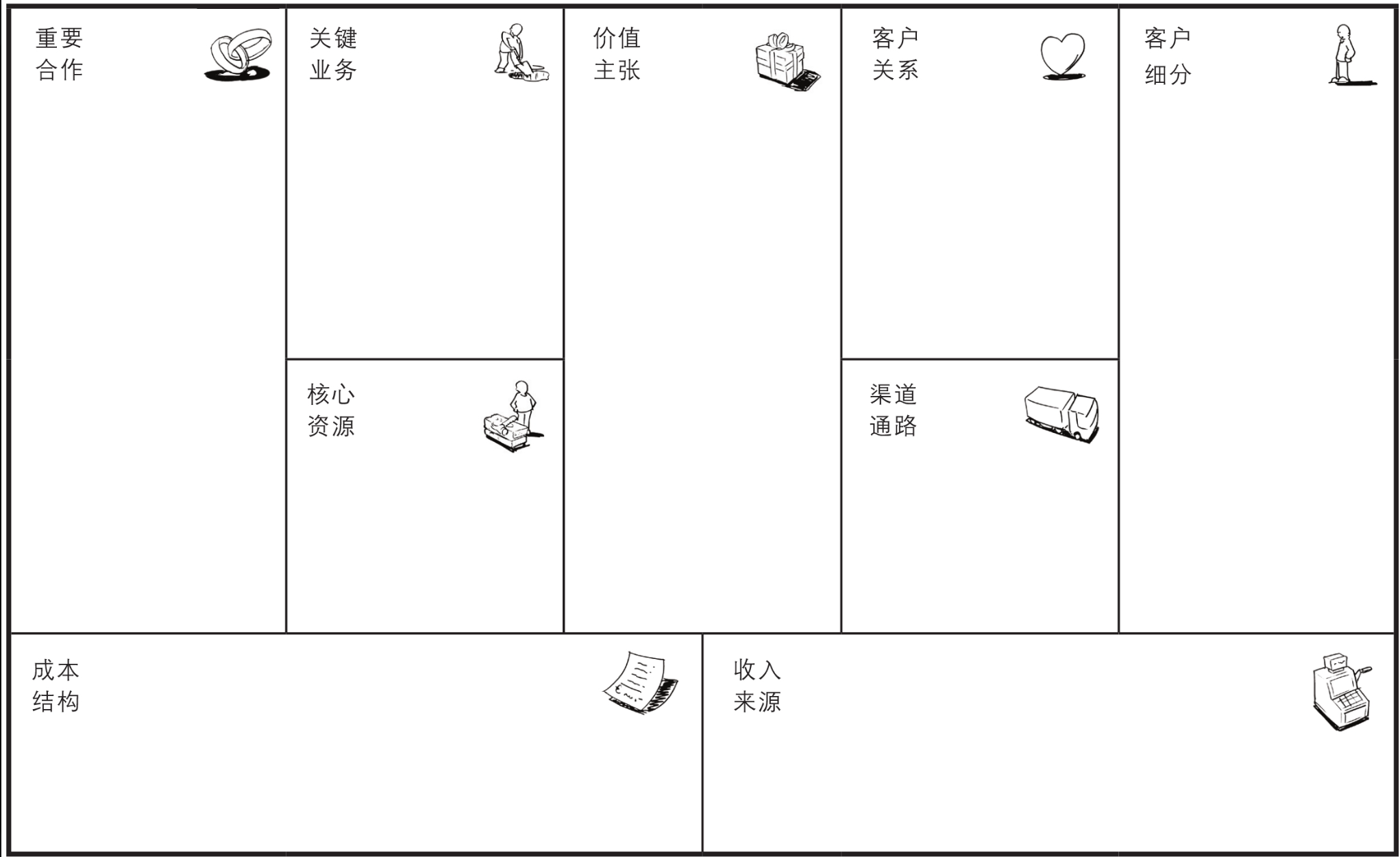
This is exactly where the value of the Business Model Canvas lies. Like a painter’s canvas, it’s preset into nine modules, on which you can describe, assess, and modify a new or existing business model. It’s simple enough to draw on a single page, yet rich enough to hold the complexity of a real enterprise.
A business model describes the rationale of how an organization creates, delivers, and captures value.
This definition itself is exquisite. It emphasizes three actions: create, deliver, capture. Many startup projects die from “creating value but failing to get it into users’ hands,” and many mature enterprises are trapped in “being able to deliver value but not getting a fair return.” The role of the canvas is to force you to see all three things clearly at once.
The image below is the classic structure of the Business Model Canvas — nine modules together forming a one-page panorama of business logic:
2. The Nine Modules: From Customers to Costs
The book breaks the business model into nine modules, which can be understood in four groups:
1. The Customer Side: Segments, Value, Channels, Relationships
Customer Segments answer “for whom are we creating value.” The authors stress that a company must carefully choose whom to serve and whom to ignore. Customer groups can be a mass market, a niche market, segmented multiple niches, or two interdependent multi-sided markets. The latter is very typical — for example, a free newspaper serves both readers and advertisers at once, and neither can be dispensed with.
Value Propositions are the reason customers choose you over a competitor. The book lists multiple sources of value: innovation, performance, customization, concierge service, design, brand, price, cost reduction, accessibility, and convenience. What impressed me most was Rolls-Royce’s engine service billed by flight hour — it no longer sells a “product,” but a “result.” This shift from ownership to usage rights is itself an innovation in the business model.
Channels describe how value reaches customers. A channel may cover five phases: awareness, evaluation, purchase, delivery, and after-sales. Owned channels have high margins but scale slowly; partner channels have thin margins but let you leverage others. The difficulty lies in integrating the various channels to find the best balance.
Customer Relationships focus on how to acquire, retain, and grow customers. From dedicated account managers, self-service, and automated service, to user communities and co-creation, the depth and cost of relationships vary enormously. YouTube letting users generate content and then broadcasting it to the public is essentially a customer relationship that turns users into collaborators.
2. The Revenue Side: Revenue Streams
The book lists seven typical revenue models: asset sale, usage fee, subscription fee, lending/renting, licensing, brokerage fee, and advertising. Which revenue method you choose depends on what customers are truly willing to pay for.
Many internet companies look free, but in fact “sell” user attention to advertisers; SaaS companies use subscriptions to turn one-time revenue into a continuous cash flow. Once the revenue model changes, the entire cost structure, customer relationships, and even the value proposition change along with it.
3. The Resources and Capabilities Side: Key Resources, Key Activities, Key Partnerships
Key Resources fall into four types: physical, intellectual, human, and financial. Intellectual resources (brands, patents, customer databases) are increasingly important in modern business, and once established, the barrier is extremely high.
Key Activities correspond to three typical models: production, problem-solving, and platform/network. A consulting firm is a classic example whose key activity is “solving problems”; while platform enterprises like Apple and Amazon have their core capability in maintaining a network ecosystem.
Key Partnerships explain why few companies do everything themselves. Partnerships can bring scale effects, reduce risk, and acquire scarce resources. Blu-ray technology, jointly developed by a group of consumer-electronics giants, is a classic example of “coopetition”: they cooperate on the technical standard and compete on product sales.
4. The Economic Side: Cost Structure
The cost structure can be divided into two types: cost-driven and value-driven. The former pursues extreme low cost and automation; the latter is willing to pay a higher cost for brand, experience, and customization. Costs are also affected by fixed costs, variable costs, economies of scale, and economies of scope.
3. The Canvas Is a Way of Thinking
After reading this book, I feel the greatest value of the Business Model Canvas isn’t just “drawing it out,” but the several ways of thinking it brings:
First, systems thinking. Changing one module, you must look at its impact on the other eight. For example, if you want to shift from selling products to a subscription model, this changes not only the revenue stream, but also customer relationships, channels, key activities, and even key resources.
Second, visualization. Putting assumptions on paper lets the team discuss around the same diagram. Many disputes within startup teams actually stem from inconsistent understandings of the business model.
Third, experimentability. Every module on the canvas is a hypothesis that can be validated. Is the customer segmentation accurate? Is the value proposition recognized? Are the channels efficient? The canvas turns a business model from a static plan into a set of testable propositions.
4. Lessons from the Apple iPod/iTunes Case
The book uses Apple’s 2001 launch of the iPod/iTunes to illustrate the application of the canvas. Apple didn’t just sell an MP3 player; what it offered was “a complete, convenient experience of digital music from search, purchase, and download to use.” This is the ultimate embodiment of convenience/practicality as a value proposition.
Looking one layer deeper, the iPod and iTunes are mutually locked: hardware drives software, software binds hardware, and the music content is supplied by record labels. This prototype of a multi-sided platform let Apple gradually transform from a computer company into an ecosystem company. The nine modules of the canvas can present this complex transformation process clearly.
5. What It Inspired in Me
As someone who has long followed product, technology, and business, this book made me realize anew:
- A good product and a good business model are two different things. No matter how advanced the technology, if you can’t find a suitable value proposition and revenue model, it’s hard to sustain.
- A business model isn’t designed; it’s iterated. The canvas is the starting point, not the end. Real validation comes from the market.
- Innovation can happen in any module. It doesn’t have to be product innovation; channel innovation, customer-relationship innovation, and revenue-model innovation can equally bring huge competitive advantages.
Business Model Generation isn’t a book you can only read once. It’s more like a toolbox: every time you face a new project, a new opportunity, or a new challenge, you can take out the canvas and draw it all over again. That diagram of nine modules essentially reminds us: business success never depends on a single point, but on whether an entire logic is self-consistent and sustainable.
If you’re also interested in business model design, I suggest not stopping at reading — find a company you know well (it could be the company you work for, a startup project, or even your own “personal business model” as a freelancer) and try drawing its nine modules on a single sheet of A4 paper. Once you’ve drawn it, you’ll most likely have a new understanding of that company.
评论
0 条评论