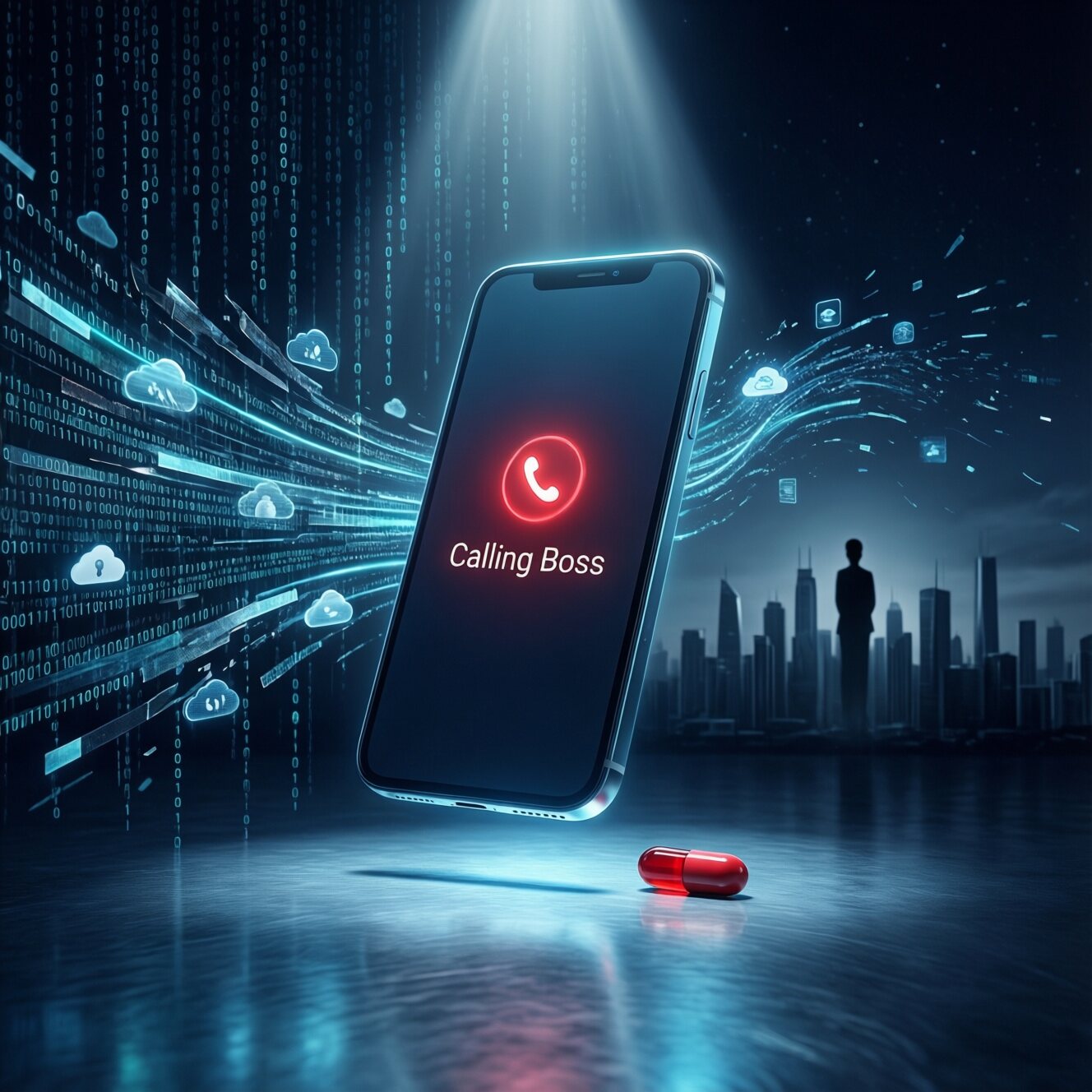
“At 3 a.m., my iPhone dialed my boss’s number by itself, while I was sound asleep.” This isn’t the opening of a horror film but a real tech panic recently circulating on social media. At the same time, Lei Jun quietly stepped down as chairman of Kingsoft Cloud, and on e-commerce platforms, the search volume for quick-acting heart pills quietly climbed.
These seemingly unrelated news items were pushed in front of us by algorithms. As a technologist, what I smell isn’t gossip but a collective anxiety about “losing control” and “losing certainty” permeating the digital-age air. The phone no longer fully obeys its owner, the helmsman of a cloud service turns and walks away, and the hot sales of heart pills are like a metaphor for the pressure of an era. Today, no gossip—we tear down the system and look at the essence.
Background: When “Intelligence” Starts Acting on Its Own, Where Is the Cornerstone of Trust?
Why did “iPhone auto-dials at night” so quickly ignite public opinion? It struck the deepest fear of users in the smart-device age: the transfer and betrayal of control.
We embrace smartphones, cloud services, and AI assistants—essentially signing an invisible contract: I transfer part of my control (like automation settings, cloud storage) in exchange for more efficient, convenient services. The cornerstone of this contract is “certainty”—the device’s behavior should be predictable and conform to settings. A midnight auto-dial is a system behavior exhibiting unpredictable “non-certainty,” directly shaking the foundation of the contract.
Similarly, Lei Jun stepping down as chairman of Kingsoft Cloud, from an industry perspective, is also a signal about “certainty.” As an independent public cloud provider, Kingsoft Cloud’s strategic continuity and long-term service stability are the key “certainty” promises that customers (especially enterprise customers) rely on when choosing it. The departure of a founding soul figure inevitably raises market doubts about whether this promise will remain solid. Especially against the backdrop of a solidified and fiercely competitive cloud-computing market, any leadership change gets magnified.
And the quick-acting heart pills—this seemingly abrupt data point—is perhaps the most direct, most physiological manifestation of this pervasive anxiety on the consumer end. The sense of “losing control” in the digital world is translating into tension and pressure in the physical world.
So the common core of these three things is: in an age of ever-increasing system complexity and automation, how do we guarantee and rebuild the user-perceivable “certainty”? This is an engineering problem, and even more a product-philosophy problem.
Technical Breakdown: Behind Auto-Dialing Is a Battle Against the “Entropy Increase” of Complex Systems
Let’s first dig into the specific technical nightmare of “midnight auto-dialing.” Apple’s official response usually points to a “software bug” or “accidental trigger,” but that’s too vague. From an engineering standpoint, this is most likely a chain reaction caused by multiple subsystems interacting unexpectedly under edge conditions.
The calling logic of a modern smartphone is long past a simple “tap the dial pad - send a signal.” It involves a complex, event-driven architecture:
|
A possible fault-chain inference (one hypothetical scenario):
- Trigger source: perhaps “Voice Control” (mis-recognizing ambient noise as a command), some gesture configuration in “Accessibility” being accidentally triggered, or even a “Shortcuts” automation executing an action containing “call” when a specific time/location condition is met.
- Condition conflict: the phone may be in “Bedtime mode” or “Focus mode,” which should suppress notifications and incoming calls. But if the subsystem triggering the call has too high a permission, or the mode-management service (Daemon) fails to respond in time due to resource strain or being optimized in the background, the suppression logic may fail.
- Authentication bypass: Face ID/Touch ID usually needs biometric authentication to perform sensitive operations (like dialing a contact) on the lock screen. But if the trigger comes from a system-level service granted “trusted” permission by design (e.g., for the convenience of people with disabilities), it may bypass the user-level instant authentication.
- Chain reaction: the above multiple low-probability events occur simultaneously at a specific point in time (like when the system is doing a silent OTA update and partially restarting some services), causing the final unexpected behavior.
The essence of the problem is that as features explode, iOS (or any complex OS) has become a distributed system of hundreds of collaborating microservices and processes. Each individual feature module (voice, accessibility, Shortcuts) may work fine in testing, but the combined state space between them is an astronomical number that cannot be covered by exhaustive testing. Under complex interactions and edge conditions (low battery, memory pressure, network switching, multiple services waking simultaneously), behaviors the designers never anticipated emerge—“non-certainty” faults.
It’s like operating a massive microservice cluster: service A and service B each run fine alone, but once they interact in a specific order and under pressure, a deadlock or data error can result. The phone is a super-complex micro data center held in everyone’s hand.
My Cool-Headed Reflections: Have We Pursued “Automation” Excessively While Ignoring “Explainability”?
Facing problems like this, the industry’s and users’ instinctive reaction is often: strengthen testing, refine algorithms, fix bugs. That’s not wrong, but it’s at the level of “technique.” I want to raise a cool-headed reflection at the level of “the Way”: in the wave of AI and automation, have we fallen into a kind of “intelligence vertigo,” sacrificing the system’s “explainability” and “final arbitration by the user” for extreme convenience?
1. The “black box” trend turns users into “digital sharecroppers”
Today’s smart devices are increasingly like black boxes. Users know what they input and what output they get, but why a certain decision was made in between (like why it suggests calling someone at this moment) is completely unknowable. When the system errs, users can’t correct it and can’t even understand where the error came from—they can only blame it on a “paranormal event.” This powerlessness is the root of trust erosion. We enjoy the dividends of automation but cede the right to understand and control, as if farming on a digital lord’s land.
2. Feature stacking and “complexity debt”
Anyone who’s built enterprise-grade systems knows that technical debt includes “code debt” and even more “complexity debt.” For market competition, vendors love to stack new features (new gestures, new voice commands, new automation scenarios), and each feature brings new states and interaction possibilities. This complexity accumulates like interest, and one day the system’s complexity will exceed the comprehension of any single engineer or team, causing unpredictable, bizarre faults. The iPhone’s “auto-dial” may be a sign that Apple, after years of feature sprinting, has begun repaying its “complexity debt.”
3. The absence of ethical design: what should be the default?
When a “Shortcuts” automation allows setting “auto-message family when I get home to reassure them,” should it by default prohibit “auto-calling a colleague at 2 a.m.”? This isn’t just technical logic but product ethics. While providing powerful automation, does the system have a responsibility to build in some “safety guardrails” consistent with common sense and social norms? Currently, many designs appear value-neutral, even naive, leaving all judgment of responsibility and risk to the user.
Lei Jun leaving Kingsoft Cloud, in this context, can also be seen as the pursuit of another kind of “certainty.” The “certainty” of a personal career may lie in seeking new challenges (like going all-in on Xiaomi’s car-making), while the “certainty” of an enterprise service needs to be rebuilt and communicated through a more solid governance structure and a clearer strategy. This is neither good nor bad but the manifestation of certainty needs at different levels.
Takeaways for Building Products: Constructing “Trustworthy Automation”
Based on the breakdown and reflections above, for teams committed to building smart products or complex systems, I have a few down-to-earth suggestions:
1. Design for “certainty” and “explainability,” not just features.
- Build a “user-perceivable state” system: let the device’s key states (like “why it’s about to perform this action”) be prompted to the user in a simple, clear way. For example, before executing any automated call, even if authorized, show a non-ignorable prompt on the lock screen: “Shortcut ‘Get Home’ is about to call your wife, tap to cancel.”
- Provide an “automation provenance” log: offer a clear log in Settings recording all recently triggered automated actions and their trigger reasons (time, location, network conditions, etc.). When users encounter bizarre events, they can self-check instead of only posting online.
2. Embrace “complexity governance” and set up “automation fences.”
- Run chaos-engineering tests on cross-feature interactions: like Netflix, proactively inject faults into your own mobile OS, simulate edge cases, and test whether different automation services’ interactions under pressure produce “emergent faults.”
- Set risk levels and safe defaults: classify automated actions by risk (like “send message” as medium, “financial transaction” and “make a call” as high). For high-risk actions, set stricter default safety policies (like prohibiting execution during late-night hours, requiring second confirmation).
3. Make “elegant exit” a core experience.
- Ensure there’s always an “emergency stop” button: whether a physical key combination (like holding the volume keys) or a global, high-priority software switch, the user must be able to quickly stop all automation and return to full manual control in any situation. This “escape pod” design is the ultimate guarantee for building user security.
- Transparent communication about service changes: for cloud services or long-term software services, leadership changes and architectural adjustments are inevitable. But how you communicate is crucial. A clear roadmap, a firm commitment to customer data and business continuity, and a smooth handover all maintain another kind of “certainty.” What Kingsoft Cloud needs to do is rebuild the market’s confidence in certainty through concrete actions going forward, not just announcements.
Conclusion
The history of technological development is a history of humanity continuously delegating control to machines and continuously struggling with machines’ “losing control.” From the steam engine’s flywheel to the operating system’s blue screen, and now to AI’s hallucinations—it’s all the same.
“iPhone auto-dialing” and “Kingsoft Cloud’s personnel change” are two tiny slices of this super-automated, highly interconnected age, together reminding us: true intelligence isn’t making the system omnipotent but, while granting it capability, carefully safeguarding that precious, predictable trust between humans and machines.
As builders, our task isn’t to create astonishing but occasionally “unhinged” geniuses, but to forge reliable partners with steady behavior, traceable actions, and who always return final control to people. After all, in the digital torrent, users need not just a quick-acting heart pill but a digital environment that lets them rest easy and not need to take one.
This road is far harder—and far more important—than stacking the next cool feature.
评论
0 条评论