The content of this article is based on reading notes and was generated by AI.
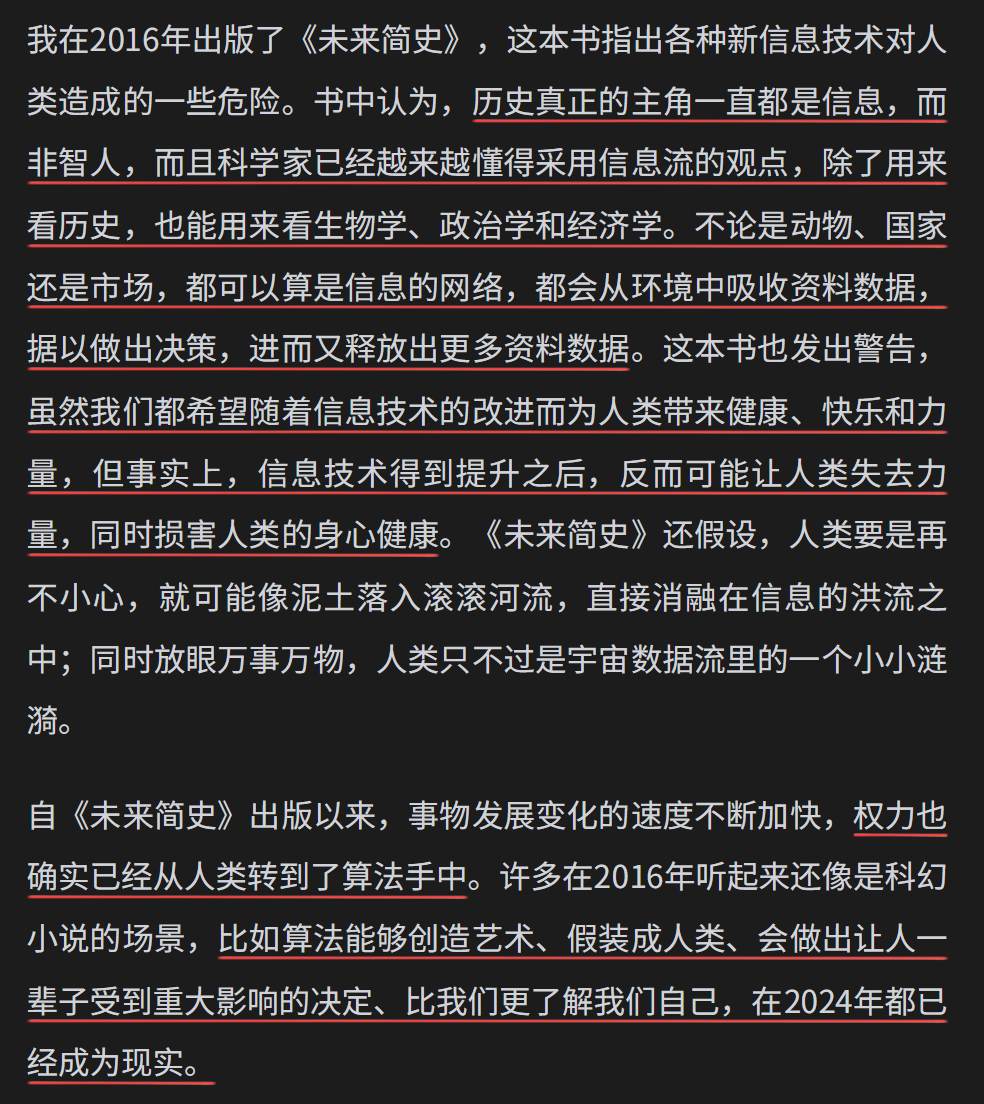
From the primitive collaboration network built on the birth of language, to the global information interconnection realized by the internet, to the era of intelligent decision-making dominated by AI algorithms, information technology has always been regarded as the core driving force advancing human civilization. We once firmly believed that every breakthrough in technology would bring humans a healthier body, richer happiness, and greater power. Yet when navigation replaces our ability to find the way, algorithms dissolve independent thinking, and AI replaces repetitive labor, beneath the halo of technological progress a silent backlash is quietly unfolding. While embracing the convenience of information, humans gradually lose their capacity for autonomy, damage their physical and mental health, and become appendages of the information-flow network they themselves created. The Israeli historian Yuval Noah Harari, in Nexus (《智人之上》), offers a core perspective—“information is the true protagonist of history”—which provides the underlying logic for us to dismantle this paradox: when the goal of technological development departs from human happiness, and when control over information is monopolized by power and capital, information technology is alienated from an enabling tool into a shackle that weakens humanity.
The alienation of information technology is, in essence, a misalignment between the goals of technological development and human needs. Driven by both capital and power, the core logic of technological iteration has long shifted from “serving humanity” to “self-expansion” and “value appreciation.” This directional bias directly produces the symbiotic predicament of technological empowerment and human “de-skilling.” Looking back at the development of information technology—from the invention of the computer to the spread of the internet to the rise of AI—every breakthrough advertised itself as “improving efficiency and liberating manpower.” Early internet believers firmly held that the free flow of information could break the monopoly of authority, eliminate cognitive barriers, and let humans achieve a leap in capability through equal access to information; when AI was first born, it too was depicted as good news that “liberates repetitive labor and lets humans focus on creation.” Yet reality has moved in the opposite direction from the original intent.
For capital, the core value of information technology lies in reducing costs and harvesting dividends, not in protecting workers’ rights. In the internet industry, the spread of AI generation tools has multiplied the efficiency of requirement writing, code development, content creation, and similar work. A requirements document that once took several all-nighters can now have a first draft generated by AI with a single instruction; code that once needed a team to collaborate on and debug can now be optimized by smart programming tools in milliseconds. For capital, this efficiency gain means a massive compression of labor costs—the more mature the technology, the lower the worker’s irreplaceability. Many practitioners find that technological progress has not brought lighter work and higher pay but instead more stringent output demands and higher unemployment risk: completing one requirement in a day used to be passing; now, with AI tools, capital demands three or more a day. The intensifying 35-year-old workplace crisis is essentially technology substitution robbing middle-aged workers of the “labor-cost” advantage, turning them into a cost item that can be replaced at any time. Capital harvests all the value created by technology while shifting the risks of technological iteration onto workers, forming the distorted pattern of “the faster technology advances, the more fragile the worker.”
The monopoly of power over information further intensifies the loss of human power. Harari stresses in Nexus that “the essence of power is control over information”—whether it’s a state bureaucracy or a tech giant, both shape narratives that serve their own interests by controlling the production, filtering, and dissemination of information, thereby dominating human cognition and decision-making. In the algorithmic era, this monopoly becomes more hidden and efficient. The core logic of the algorithm is to “cater to your taste”: by analyzing users’ browsing records and interaction behavior, it keeps pushing homogeneous content, building an airtight “information cocoon.” We think we’re freely choosing information, but in fact we’re being precisely fed by the algorithm; we think we’ve grasped the truth of the world, but in fact we only see the partial fragments that power and capital want us to see.
Tech giants push algorithmic fodder like “AI makes work more efficient” and “digitalization boosts happiness,” yet stay silent on problems like technology replacing jobs and leaking data privacy; some platforms deliberately amplify “success-story narratives,” defining “making big money and climbing to high positions” as the value of life, while covering up the reality that most people are swept along by technology and trapped in anxious internal churn. This targeted information output makes the naive view of information take deep root—the idea that “the more information, the more mature technology, the more powerful humans become.” But the facts are exactly the opposite: the more information, the greater the possibility of humans being guided and manipulated; the more technology develops, the easier it is to hand over humans’ right to choose autonomously. When eating depends on food recommendations, travel depends on routing algorithms, and even career choices depend on matching systems, humans gradually give up the will to decide independently, hand the right of choice to the “algorithmic authority,” and ultimately lose the capacity for independent thinking and diversified judgment. In key fields like healthcare, justice, and finance, the spread of algorithmic decision-making further greatly weakens humans’ individual will—when a person’s diagnosis or a judicial verdict is decided by cold code, human agency and dignity are quietly dissolved.
Through algorithmic feeds of fodder like “AI makes work more efficient” and “digitalization boosts happiness,” they stay silent on problems like technology replacing jobs and leaking data privacy; even more directly, they use algorithms to achieve precise harvesting of interests. The algorithms of Meituan and Ctrip dynamically adjust the prices of goods and services based on users’ consumption habits, geographic location, and even real-time demand—for the same hotel room or food-delivery combo, the price different users see can be worlds apart. This “algorithmic price discrimination” is essentially a hidden squeezing of interests under an information monopoly. Nvidia and Google, by controlling chip technology and search traffic, have monopolized the core information gateways of the AI era; the technology news and industry data ordinary people obtain have all been filtered and processed by them. What we think of as “technology for all” is in fact an “information fence” drawn by the giants.
Information technology’s damage to human physical and mental health is the direct result of the incompatibility between technological logic and humans’ biological nature and psychological needs. As a product of biological evolution, humans are naturally suited to dynamic physical activity and deep emotional connection, yet the virtual world built by information technology traps humans in front of static screens, severs real social relationships, and ultimately triggers a dual alienation of body and mind. At the physical level, the spread of information technology has shifted human lifestyle from “dynamic” to “static,” making sedentary work and phone addiction the norm. Tasks that once required walking to commute or face-to-face communication can now be done by sitting and clicking a mouse or swiping a screen; the reduction of physical labor and the excessive use of electronic products directly cause a flood of “modern diseases” like obesity, cervical spondylosis, and dry eye, and declining eyesight among teenagers and sleep disorders among adults become common problems. Even if some people fight this alienation through exercise, it’s hard to escape technology’s interference with the body’s rhythm—unable to resist scrolling their phone while running, addicted to short videos to relax after a workout; the body’s active movement ultimately struggles to offset technology’s penetration into life.
At the psychological and spiritual level, the harm brought by information technology is more hidden and profound. The internet makes communication convenient, yet makes emotional connection shallow. We can chat with dozens of people on WeChat at the same time, yet find it hard to have a heart-to-heart face-to-face exchange; we can harvest thousands of likes on social media, yet find it hard to gain true emotional resonance. This “shallow socializing” intensifies loneliness and a sense of emptiness, making many people pin their self-worth on virtual traffic data and fall into endless comparison and internal churn. More seriously, the “fragmentation” characteristic of information technology is destroying humans’ capacity for deep focus. Content forms like short videos, short news, and instant messages cater to humans’ psychology of instant gratification, yet keep cutting our attention apart, making it hard to calm down and read a thick book or do something requiring long-term investment. Deep focus is the core ability for humans to create value and gain a sense of achievement; when this ability regresses, spiritual emptiness and self-doubt follow, then triggering psychological problems like anxiety and depression.
From the perspective of biology and sociology, human power has never come from an individual’s physical strength or intelligence but from the ability to build large-scale collaboration networks. Harari points out that the reason Homo sapiens could rule the earth is fundamentally that they built collaboration networks transcending biological instinct through fictional stories (nations, money, religion). Now, AI and algorithms are building a set of non-biological information networks independent of humans; the collaboration efficiency of this network far exceeds that of humans and is gradually replacing humans’ core position in social production. The smart scheduling systems of e-commerce platforms can coordinate logistics, inventory, and transactions more efficiently than humans; the high-frequency trading algorithms of financial markets can complete decisions in milliseconds, something human traders simply cannot match; the spread of industrial robots has greatly reduced the manpower demand of traditional manufacturing. As the efficiency and scale of non-biological networks keep breaking through, humans’ irreplaceability in social collaboration keeps declining, and the collaboration rights and voice that originally belonged to humans are being quietly transferred to technology.
What is worth vigilance is that this loss of power and physical-mental damage is not the fault of technology itself but a problem with technology’s distribution rules and governance system. As a neutral tool, technology can both create value and bring risk; the key lies in “who controls the technology,” “who enjoys the dividends,” and “who bears the risk.” The current predicament is essentially that control over technology and the right to distribute value are monopolized by capital and power; ordinary people have only the right to use technology but cannot participate in making technology’s rules, and ultimately become sacrifices to technological expansion. To break this predicament requires both awakening and resistance at the individual level and institutional improvement and value reconstruction at the social level.
For individuals, the core of breaking technological alienation is to rebuild autonomous capacity and hold on to human uniqueness. In the AI era, repetitive labor and standardized work are easily replaced, whereas abilities relying on emotional perception, creative thinking, and value judgment are humanity’s core competitiveness. We can use AI tools to improve efficiency, but we cannot give up independent thinking and deep creation—after using AI to generate a requirements document, persist in independently optimizing the logic and filling in the details; when relying on algorithms for information, actively break out of the cocoon and engage with diverse views. At the same time, deliberately cultivate the ability for deep focus and real social connection, reduce dependence on electronic products, and rebuild the balance of body and mind through reading, exercise, and face-to-face communication. Workplace people especially need to build an “irreplaceable ability barrier,” shifting from “technology operator” to “value creator,” focusing on work that requires long-term experience accumulation, cross-domain integration, and humanistic care, and holding on to their core value amid technological iteration.
At the social level, a sound technology governance system needs to be established so that technological development returns to the original intention of “putting people first.” The government should strengthen regulation of algorithms, break the tech giants’ information monopoly and data hegemony, and protect users’ information privacy and right to know; improve the labor-protection system to cope with the unemployment brought by technology substitution, and provide support for workers’ transition through vocational training and social security; promote the fair distribution of technology’s value so that workers can also share the dividends of technological progress, rather than only bearing the risk. At the same time, break the naive cognition of “technology supremacy” and establish a rational view of technology—acknowledging technology’s limitations, guarding against technology’s erosion of humans’ autonomous capacity and dignity, and finding a balance between technological development and human welfare.
From the perspective of information flow, the evolution of human civilization is always an interactive process between information networks and humans themselves. The progress of information technology itself is not the endpoint but a means for humans to achieve a freer and happier life. When technological alienation backlashes against humans, we need not despair of technology but should reflect on the direction and rules of technological development. Just as Harari warns in Nexus, humanity’s future lies not in pursuing more powerful technology but in controlling its direction, making the information network serve the overall interests of humanity rather than subverting humanity’s dominant position.
In this game between humans and technology, human power lies not in fighting technology but in holding on to our own uniqueness and subjectivity. Only by breaking the information monopoly, reconstructing the distribution of value, and rebuilding autonomous capacity can information technology return to its enabling essence, and can humans, amid the waves of information flow, both enjoy the dividends of technological progress and hold on to the freedom and dignity of body and mind. This is both a resistance against technological alienation and the necessary path for human civilization to achieve self-redemption in the new era.
评论
0 条评论