1. The Trap I Was Designed Into
Many years ago, I had a credit card. Then a second, a third. When I swiped, I felt nothing; when I paid in installments, I thought “I can afford it anyway.”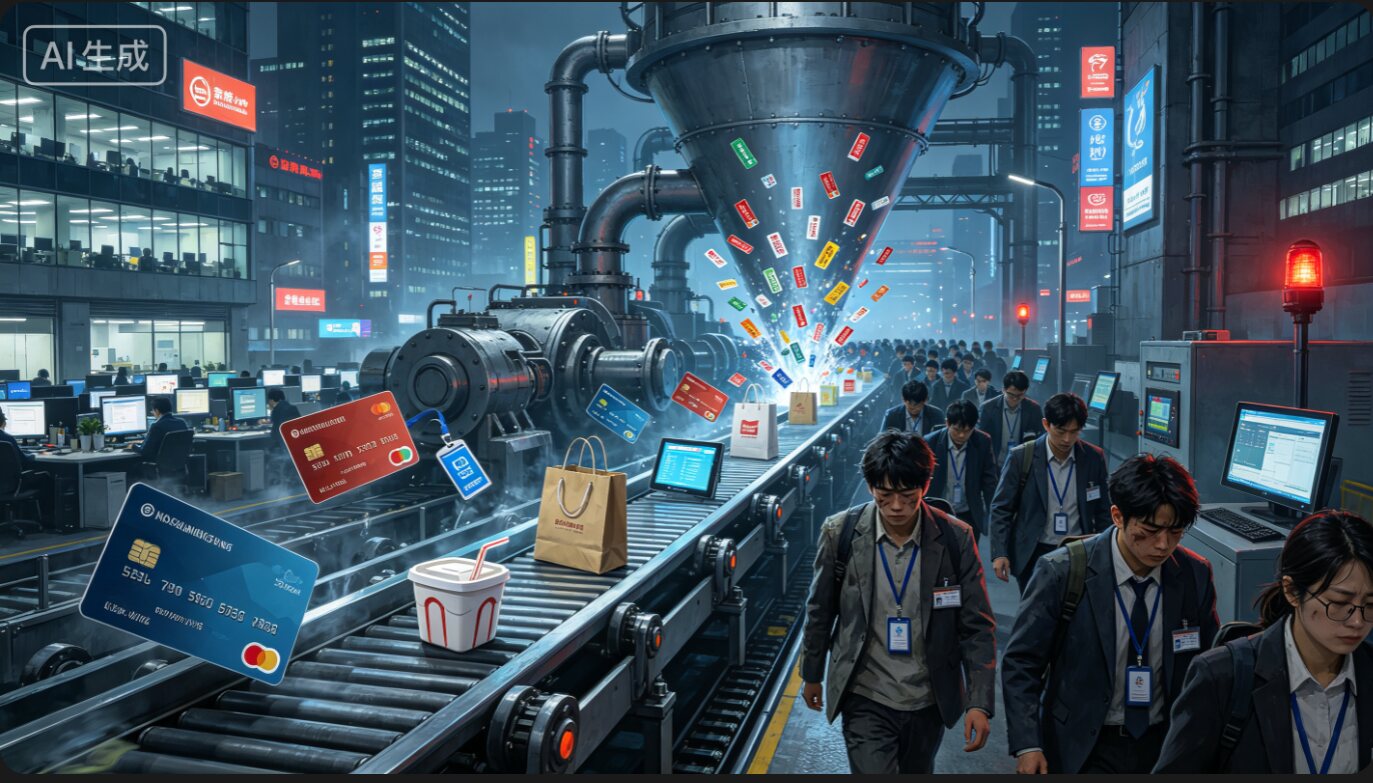
Until I discovered I was being charged interest at five ten-thousandths a day, interest compounding on interest, rolling bigger and bigger. The bank started calling, then called every day. I once did the math: installment fees plus compound interest came to an effective annual rate of nearly 20%. The things I bought — clothes, electronics, restaurant gatherings — I long ago forgot, but the debt was like a rope, tightening and tightening.
Later I gritted my teeth and paid it all off. Paid it off in full, closed the cards, kept only one, and never again paid in installments.
This isn’t an inspirational story of “financial awakening.” This is me personally experiencing a capture mechanism that was designed in advance — from consumption impulse to debt bondage, every step an automated process. Identify the trigger points (ads, social display, limited-time offers), execute the action (swipe, installment, minimum payment), continuous feedback (bills, collection calls, credit anxiety), and finally lock in the user (debt inertia makes it impossible for you to escape). I later built enterprise RPA systems and found this logic is exactly the same as corporate automation — only the object changed from work tickets to living people.
2. Bauman Was Right: Economic Growth Depends on Consumers’ “Enthusiasm”
Zygmunt Bauman wrote a passage in Work, Consumerism and the New Poor (《工作、消费主义和新穷人》) that left me stunned for a long time after reading it:
“In a consumer society, economic growth depends less on ‘national productivity’ than on the enthusiasm and energy of consumers.”
My early credit-card debt was proof that my “enthusiasm and energy” had been harvested. The bank didn’t need me to produce anything, didn’t need me to create anything; it only needed me to consume continuously, impulsively, and recklessly. My debt was their asset; my anxiety was their profit.
Even more ruthlessly, the consumer society defines “not consuming” as a kind of failure. Not chasing the latest phone? Out of date. Not checking in at the trendy restaurant? Boring. Not stocking up during Double Eleven? Missing out on a fortune. I only later understood that these aren’t “social consensus” — they’re implanted commands — keeping you continuously in a state of “doubt and dissatisfaction,” doubting that what you have isn’t good enough, dissatisfied with what you already own, so there’s always a next purchase impulse.
3. Ten Hours on the National Day Highway: I Saw the True Face of the “Holiday”
Last National Day, I drove back to my hometown near Hangzhou. The Hangrui Expressway, usually three and a half hours, took me over ten.
It wasn’t an accident — just too many cars. Half an hour queuing for gas at a service area, inching along at the toll booths, and the last few kilometers to the scenic spot took two hours. Once I got there, it was a sea of people, hotel prices tripled, and restaurant queues left you so hungry you got past it.
I spent three times more money than usual for an experience ten times worse than usual. I came back more tired than from work.
Then I understood: this isn’t an accident — it’s designed. The free highway is to get you out the door, the scenic-spot price hikes are coordinated pricing, and the congestion is a screening mechanism — only people who can bear high costs are the target consumers. My time cost, energy drain, and downgraded experience aren’t counted in any economic ledger, but the GDP numbers look good and the local consumption data looks good.
The holiday isn’t for you to rest — it’s for you to consume. Shifting days off to piece together a long holiday is about creating a “concentrated consumption window.” Rest gets redefined: rest = consumption, relaxation = spending money, treating yourself = buying. Real “rest without consuming” instead becomes the odd one out.
I did the math: the ten hours stuck on the road, converted at a technical-consulting hourly rate, was a loss of several thousand yuan. Add the extra spent on hotels, dining, and tickets, and it was enough for me to live comfortably in Hangzhou for a month. But this money didn’t improve any of my structural situation — the mortgage still had to be paid, children’s education still had to be paid, parental support still had to be paid. It merely completed one designed economic cycle.
4. Double Eleven and 618: Naked Harvesting That Needs No “Holiday” Cover
National Day at least wears the cloak of “tradition.” Double Eleven and 618 are more direct — needing no cultural excuse at all, inventing festivals out of thin air.
Double Eleven was originally “Singles’ Day,” turned by Alibaba into a shopping festival. 618 is JD’s store anniversary, now a nationwide stocking-up day. Mall promotions come every month: Goddess Day, Mother’s Day, Father’s Day, back-to-school season, mid-year celebration, store anniversary… the calendar is filled with consumption nodes, with no blank space.
These “festivals” have a few common features:
Manufacturing the illusion of scarcity. “Lowest price of the year,” “today only,” “half price for the first 1,000” — time pressure and stock anxiety force you to order immediately, giving you no room to think.
Defining “not buying” as a loss. “Miss it and wait a year,” “not buying is losing out” — consumption turns from “buy when you need it” into “lose out if you don’t buy.”
Using complex rules to burn up cognition. Pre-sales, deposits, cross-store spend-and-save, category coupons, red-envelope rain, team bargaining… after all the calculating, many people buy things they don’t need just to hit a spend-and-save threshold, and the money saved is far less than the extra spent. But what the platform wants isn’t for you to save money — it’s for you to spend more time, more attention, and more emotion in this game.
Packaging consumption as “treating yourself.” “You’ve worked hard all year, be good to yourself,” “life needs a sense of occasion” — binding consumption to emotion, making you pay for feelings.
Just like the National Day congestion, Double Eleven’s logistics collapse, customer-service queues, and difficult returns are all systemic byproducts. The platform has done the math: the loss in user experience is far lower than the GMV growth brought by peak traffic. Your dissatisfaction isn’t worth mentioning in the earnings report.
5. Consumer Goods Are Covered All Over With Death Warnings
Bauman has another line, even more ruthless than “the enthusiasm of consumers”:
“Consumer goods are covered all over with death warnings, though written in invisible ink.”
Consumer goods begin dying the moment they’re produced. A new phone is released and the old model is “outdated”; this season’s clothes come off the shelf and become “last season’s”; a restaurant’s new menu goes live and last year’s signature dish is no longer worth photographing. This death isn’t physical damage — it’s symbolic death: eliminated by the definition of “new,” buried by the iteration of “trends.”
The things I bought on installments in my early years are basically all gone now. I’ve gone through three or four rounds of phones, don’t know which business trip I lost the earphones on, donated or threw away the clothes, and the memory of restaurants blurs into drinking sessions and social obligations. But the bills were real. The credit record was real. The tone of the bank’s collection calls was real.
This is what Bauman calls the “invisible ink” — you can’t see the death warnings on consumer goods, but they’ve always been there, until you pay the price and only then discover them. A product’s life cycle is deliberately designed to be very short, but the cycle for paying for it is designed to be very long. A product loses its halo in three months, but the debt takes you three years to repay.
Deeper still, consumerism turns people into consumer goods too. Your skills, your image, your social media accounts, your lifestyle — all need continuous updating, or they’ll be “outdated.” At 35 in the tech industry, this feeling is very direct — if you don’t chase new frameworks, don’t learn large models, don’t rack up certificates, you’re defined as “aging.” People, like products, get death warnings written on them.
So my strategy now is essentially not “minimalism” or “frugality,” but refusing to become a fast-moving consumer good. It’s not refusing to update; it’s refusing to let other people’s timetable define your update cycle.
I’ve begun consciously extending the usage cycle of some things:
On devices, my main laptop is a 2019 MacBook Pro — six years old now, memory maxed out, entirely enough for daily code-writing and script-running, only going to the cloud when running local large-model inference. My phone, too, I only replace when the battery really can’t hold up and the system really slows down my workflow.
In life, I buy fewer clothes but wear them longer — basics, dark colors, good fabric; one coat worn for seven or eight years. Many things at home are “used until they break.”
Extending the usage cycle isn’t hoarding — it’s fighting the built-in death clock. When something really breaks or isn’t enough, I’ll replace it; but I won’t replace it because “a new model came out” or “it’s outdated.” This is consistent with the thinking behind building RPA systems: a good automation process isn’t rewritten every few days — it’s designed with core logic stable enough to run for a long time.
6. My Choice: Opting Out of This Game
Bauman’s insight into “norms” is even more ruthless:
“The only purpose of any norm is to use people’s agency of free choice to limit or completely eliminate freedom of choice: apart from the options the norm advocates, people have no other choice.”
This sentence spells out my early predicament completely. The consumer society never directly orders you what to buy; it only makes you feel “it’s all your choice” — you can choose Apple or Huawei, Sanya or Dali, Li Jiaqi or Dong Yuhui. But the real options were limited long ago: you can only pick from the “consumption” menu.
“Not consuming” isn’t on the menu. If you don’t buy, you’re defined as out of date, boring, having wasted your life, shortchanging yourself. The norm erases your freedom to choose not to consume from your cognition bit by bit, until you genuinely believe: apart from the options it advocates, you have no choice.
I’m now very clear: I’d rather stay home than take part in this designed consumption.
It’s not a posture of “consumption downgrade,” not a label of “minimalist living.” It’s simply refusal — refusing to be treated as an NPC who must complete consumption tasks on time and in the required amount.
I kept the one and only credit card, but never pay in installments. For daily consumption I use a debit card as much as possible; the money spent must be a number that actually exists in the account. This strategy isn’t cool, isn’t sophisticated, but it’s effective — it removes the leverage link that consumerism most easily exploits. Installments turn “can’t afford” into “can afford the monthly payment,” turn a one-time decision into a continuous drain, and turn product desire into debt inertia. I’ve been through it; I know how that rope tightens.
Staying home isn’t “wasting the holiday” — it’s taking back my own time. Not spending money isn’t “wasting it” — it’s not trading the fruits of my labor for a garbage experience. Not posting to my social feed isn’t “not going out” — it’s not turning my own life into someone else’s advertising material.
Bauman says the consumer society needs people to “stay continuously in an inexhaustible state of excitement, continuously in a state of doubt and dissatisfaction.” The state I now choose is: not satisfied, not excited, not participating.
7. This Isn’t Passivity — It’s an Active Choice After Waking Up
Some might say: you’re being too extreme; what fun is left in life?
Fun isn’t defined by others. I don’t oppose consumption; what I oppose is designed, compulsory consumption that comes at the cost of depletion. What I oppose are the commands implanted in the brain — “you must go out on a holiday,” “you must spend money on a festival,” “you must experience life.”
I have the right to choose not to throw limited resources into a trap whose return rate is clearly negative.
Those ten-plus hours stuck on the highway during National Day — what I spent wasn’t just time and gas money, but my last trust in this system. Those years of credit-card debt — what I handed over wasn’t just interest and penalties, but my superstition toward the narrative of “enjoy now, pay later.” Now trust is at zero, and the choice is clear.
I’ve seen through this game. I’m not playing anymore.
评论
0 条评论